China’s rise as a dominant economic and geopolitical actor is the product of a coherent, multi-pillar strategy:
- Sustained infrastructure build-out at home and abroad
- Export strength paired with industrial upgrading
- Mission-driven R&D and science policy
- Rapid (if uneven) military modernization
- An increasingly sophisticated mix of economic diplomacy and soft power
In contrast, U.S. competitiveness has been blunted by:
- Runaway bureaucracy and systemic inefficiencies, regulating every element of economic activity
- Hostile environment toward small business successes, discouraging entrepreneurship and investment
- Unconscionable liability exposure, creating legal and compliance burdens that stifle growth
- Fragmented infrastructure upgrades and execution, slowing modernization and global competitiveness
- Inconsistent public R&D growth, coupled with reactive trade and technology controls
- Inefficient defense procurement, draining resources from modernization
- Retreat in development assistance and people-to-people engagement, weakening U.S. influence abroad
- Stifling strengths in elite innovation and alliances by failing to leverage them effectively
- Creating a punitive environment for success and innovation, where regulatory and political hostility penalize achievement
The U.S. is losing the race for economic dominance.
Restoring U.S. leadership requires reprioritization:
- Accelerate high-impact infrastructure
- Lock in multi-year mission R&D
- Modernize human capital pipelines
- Attack bureaucracy as the cancer of economic growth
- Reform defense acquisition
- Relaunch visible, values-based economic diplomacy at scale
The Bureaucratic Drag on U.S. Competitiveness
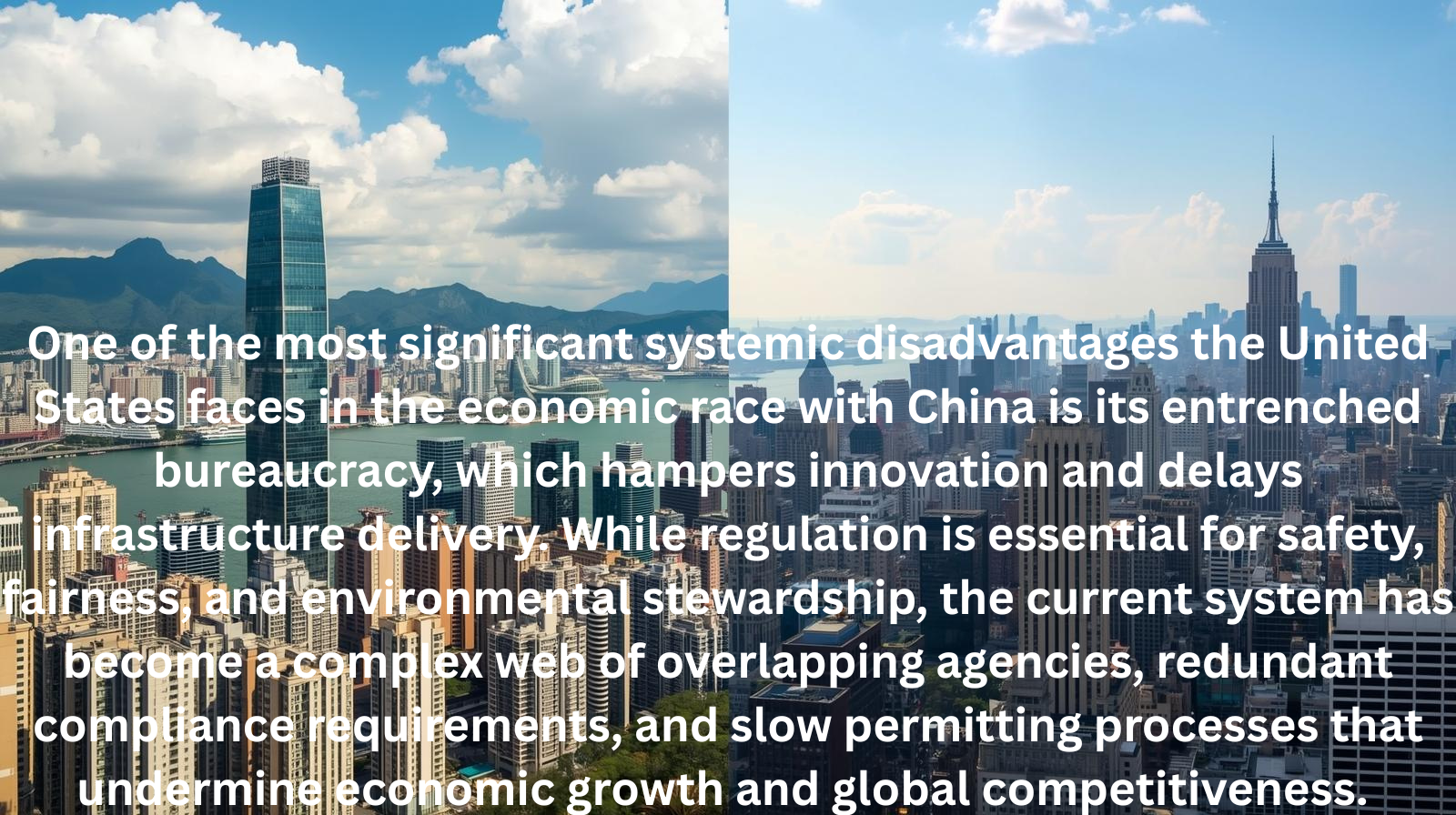
One of the most significant systemic disadvantages the United States faces in the economic race with China is its entrenched bureaucracy, which hampers innovation and delays infrastructure delivery. While regulation is essential for safety, fairness, and environmental stewardship, the current system has become a complex web of overlapping agencies, redundant compliance requirements, and slow permitting processes that undermine economic growth and global competitiveness. Addressing these issues can restore confidence in U.S. economic leadership and inspire policymakers to pursue meaningful reforms.
Key Dimensions of Bureaucratic Inefficiency
- Permitting Paralysis: Major infrastructure projects often take 5–10 years to complete environmental and regulatory reviews, compared with China’s ability to approve and execute projects within months.
- Regulatory Overreach: Businesses face thousands of pages of compliance mandates across federal, state, and local levels, creating uncertainty and discouraging investment.
- Litigation Risk: Expansive liability frameworks and class-action exposure make U.S. firms risk-averse, slowing product development and market entry.
- Fragmented Governance: Multiple agencies with overlapping jurisdictions lead to duplication, delays, and inconsistent enforcement.
- Short-Term Political Cycles: Frequent policy reversals tied to election cycles undermine continuity, making long-term planning nearly impossible.
Economic Consequences
- Infrastructure Lag: Delays in transportation, energy, and digital projects erode productivity and global competitiveness.
- Capital Flight: Investors redirect funds to jurisdictions with predictable timelines and lower compliance burdens.
- Innovation Stagnation: Startups and SMEs struggle with regulatory complexity, reducing dynamism in critical sectors such as AI, biotechnology, and advanced manufacturing.
Why This Matters
China’s centralized governance model enables rapid execution of strategic priorities—even if imperfect—while the U.S. system, designed for checks and balances, now functions as a brake on growth. Without structural reform, America’s comparative advantage in innovation and entrepreneurship will continue to erode, risking its position as a global leader and impacting national interests.
Examples of regulatory delays, such as the California High-Speed Rail Project and Keystone XL Pipeline, highlight the urgent need for reform. These delays can cause frustration and a sense of responsibility among policymakers to streamline processes and regain competitiveness.
· California High-Speed Rail Project
o Timeline: Proposed in 2008, still incomplete after 17 years.
o Cause: Environmental reviews, lawsuits, and fragmented state-federal coordination have ballooned costs from $33 billion to over $113 billion.
o Impact: China built 25,000+ miles of high-speed rail in roughly the same timeframe.
· Keystone XL Pipeline
o Timeline: First proposed in 2008, canceled in 2021 after years of permitting battles and litigation.
o Cause: Regulatory uncertainty and political reversals across administrations.
o Impact: Billions in lost investment and energy security setbacks.
· Offshore Wind Projects (Atlantic Coast)
o Timeline: Vineyard Wind took nearly 7 years to clear federal permitting before construction began.
o Cause: Multi-agency reviews and overlapping environmental compliance requirements.
o Impact: Slowed renewable energy deployment compared to Europe and Asia.
· Transmission Lines for Clean Energy
o Example: SunZia Transmission (New Mexico to Arizona) faced over a decade of delays due to federal land-use approvals and environmental Impact studies.
o Impact: Critical grid modernization projects stall, limiting renewable integration.
· Semiconductor Fab Construction
o Example: CHIPS Act incentives approved in 2022, but Intel and TSMC fabs face multi-year delays due to local zoning, environmental reviews, and workforce permitting.
o Impact: Slows U.S. efforts to counter China’s semiconductor self-reliance.
These cases show how regulatory complexity and litigation risk create systemic drag, making U.S. projects costlier and slower than those in China, where centralized decision-making accelerates execution.
Legal challenges, including multi-jurisdictional lawsuits and permitting injunctions, create systemic drag that can frustrate policymakers and stakeholders. Recognizing this issue can motivate efforts to reform legal Frameworks and accelerate project execution.
· Environmental Litigation Under NEPA and ESA
o The National Environmental Policy Act (NEPA) requires exhaustive Environmental Impact Statements (EIS) for major projects. These reviews often take years and are vulnerable to lawsuits from environmental groups, local communities, and competing interests.
o The Endangered Species Act (ESA) adds another layer, requiring habitat assessments and mitigation plans, which frequently trigger injunctions.
· Multi-Jurisdictional Lawsuits
o Infrastructure projects often cross state lines, invoking state environmental laws, federal statutes, and local zoning ordinances. Each layer creates opportunities for litigation, delays approvals, and increases costs.
· Permitting Challenges and Injunctions
o Opponents of projects (e.g., pipelines, transmission lines) use injunctions to halt construction during litigation, even after permits are granted. Courts frequently side with plaintiffs on procedural grounds, forcing agencies to redo reviews.
· Administrative Procedure Act (APA) Reviews
o Under the APA, any stakeholder can challenge agency decisions as “arbitrary or capricious.” This standard is often invoked to overturn permits, requiring agencies to restart the permitting process.
· Property Rights and Eminent Domain Disputes
o Land acquisition for rail, energy, and transmission projects triggers lawsuits over compensation and takings, adding years to timelines.
· Political and Regulatory Uncertainty
o Changes in administration lead to reversals of prior approvals (e.g., Keystone XL), creating a cycle of litigation and regulatory whiplash that discourages investment.
Impact:
These legal frameworks, while designed to protect public interests, have become tools for delay, resulting in multi-year litigation cycles, ballooning costs, and investor uncertainty. In contrast, China’s centralized governance minimizes legal contestation and accelerates project execution, illustrating how systemic inefficiencies in the U.S. hinder competitiveness and infrastructure development.
Case Studies: Legal Challenges Behind U.S. Project Delays
1. California High-Speed Rail
- Background: Approved in 2008 to connect major California cities.
- Legal Issues: Multiple lawsuits under NEPA and CEQA (California Environmental Quality Act) challenged environmental reviews, route selection, and eminent domain takings.
- Impact: Courts ordered supplemental EIS filings and halted land acquisition, resulting in years of delay and a cost increase from $33B to $113B.
2. Keystone XL Pipeline
- Background: Proposed in 2008 to transport Canadian crude to U.S. refineries.
- Legal Issues: Environmental groups filed suits under NEPA and the ESA, arguing that the climate Impact analysis was inadequate. APA challenges claimed agency decisions were “arbitrary and capricious.”
- Impact: Permits were repeatedly revoked and reinstated across administrations; the project was canceled in 2021 after 13 years of litigation.
3. Vineyard Wind (Offshore Wind Farm)
- Background: First large-scale offshore wind project in the U.S.
- Legal Issues: Lawsuits under NEPA and the Marine Mammal Protection Act delayed federal approval. Fishing industry groups filed APA challenges on economic Impact grounds.
- Impact: Seven years from proposal to construction start, slowing renewable energy deployment.
4. SunZia Transmission Line
- Background: 550-mile line to deliver renewable energy from New Mexico to Arizona.
- Legal Issues: Federal land-use approvals triggered NEPA reviews; lawsuits from conservation groups demanded route changes to protect wildlife habitats.
- Impact: More than a decade of delays before groundbreaking in 2023.
5. Semiconductor Fabs (Intel & TSMC)
- Background: The CHIPS Act incentives aimed to accelerate domestic chip production.
- Legal Issues: Local zoning disputes and environmental compliance lawsuits delayed site preparation and permitting.
- Impact: Multi-year lag in fab construction, undermining U.S. efforts to counter China’s semiconductor push.
Key Pattern:
Legal frameworks designed for accountability have become litigation tools that stall strategic projects. While checks and balances are vital, excessive procedural vulnerability creates systemic drag on U.S. competitiveness.
Recommendations for U.S. Policymakers
· Accelerate Infrastructure Delivery
o Enact permitting reform with statutory timelines and a single federal coordinator.
o Launch a Partner Infrastructure Facility with G7 allies to provide transparent, ESG-compliant alternatives to BRI.
· Lock in Mission-Driven R&D
o Authorize 10-year funding streams for AI, semiconductors, clean energy, and biomanufacturing.
o Expand DARPA-style directorates and translational grants to bridge lab-to-market gaps.
· Strengthen Semiconductor Resilience
o Coordinate export controls with allies to avoid fragmentation.
o Incentivize domestic mature-node and advanced packaging capacity; scale workforce training for fabs.
· Rebuild Human Capital Pipelines
o Establish a national apprenticeship system for advanced manufacturing and tech.
o Expand Pell Grants and targeted loan forgiveness for STEM and skilled trades; modernize K–12 STEM standards.
· Modernize Defense Acquisition
o Implement agile software development and modular open systems.
o Tie procurement to performance metrics; sunset chronically underperforming programs.
· Revitalize Soft Power
o Rebuild USAID staffing and field presence; prioritize co-created projects in emerging markets.
o Expand scholarships and STEM visa programs; launch a Digital Marshall Plan for connectivity and e-government.
· Embed Fiscal Discipline
o Adopt zero-based budgeting for federal agencies to redirect funds toward strategic sectors.
o Target $200B in annual savings for competitiveness initiatives.
Powerful quote from famous people
We cannot solve our problems with the same thinking we used when we created them.” — Albert Einstein.
“If it moves, tax it. If it continues to move, regulate it. And if it stops moving, subsidize it.”
— Ronald Reagan
“Government’s first duty is to protect the people, not run their lives.”
— Ronald Reagan
“The federal bureaucratic state has come to view its mission as to stop, slow, prevent, and block projects of significance.”
— from an op‑ed in The Hill by former President Donald Trump, highlighting how Washington’s bureaucracy obstructs infrastructure and growth initiatives
Closing Paragraph
The contest for global economic leadership is no longer theoretical—it is unfolding in real time. China’s disciplined, long-horizon strategy has positioned it as a formidable competitor, leveraging infrastructure, technology, and diplomatic influence to reshape global markets. Meanwhile, the United States is constrained by systemic inefficiencies, regulatory paralysis, and fragmented priorities that undermine its natural advantages in innovation and alliances. The choice is clear: either continue down a path of bureaucratic stagnation and reactive policy or embrace bold, structural reforms that restore agility, incentivize growth, and project leadership abroad. America’s future competitiveness depends on decisive action now—because in the race for economic dominance, delay is defeat.