Summary
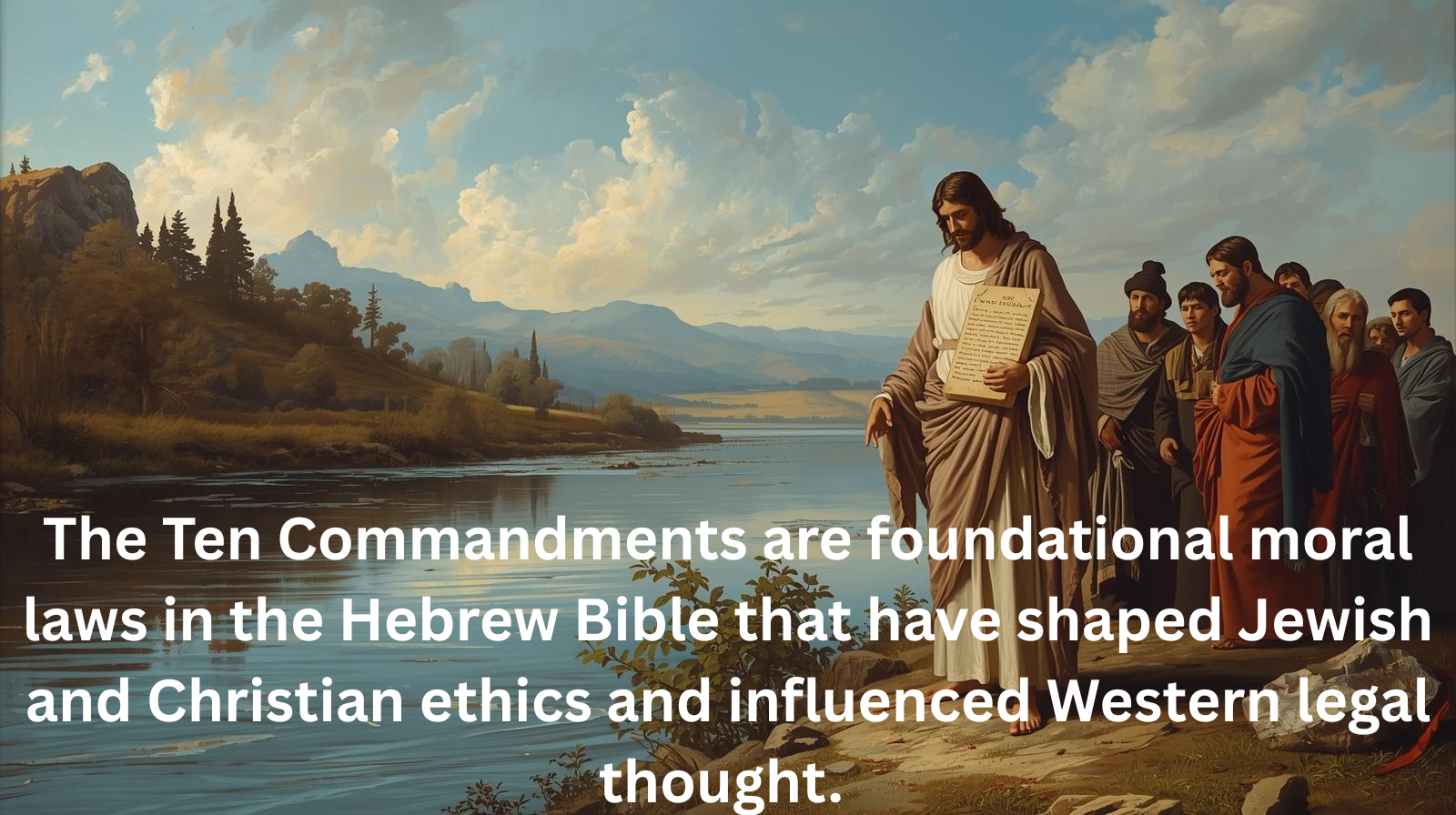
The Ten Commandments are foundational moral laws in the Hebrew Bible that have shaped Jewish and Christian ethics and influenced Western legal thought. Rooted in the covenant God made with Israel, they are recorded in Exodus 20 and Deuteronomy 5 and traditionally grouped into duties toward God (Commandments 1–4) and duties toward others (Commandments 5–10).
Jesus did not abolish these commandments; he fulfilled and deepened their meaning—bringing their intent to the heart and inaugurating a New Covenant centered on love of God and neighbor, which invites believers to see their moral life as a response to Christ’s work.
I. What Are the Ten Commandments?
1. You shall have no other gods before Me
Meaning: Exclusive loyalty to the one true God. It forbids elevating any rival ideology, person, power, or possession above God.
2. You shall not make idols
Meaning: Prohibits worshiping created images or objects. Idolatry misdirects trust from the Creator to created things.
3. You shall not misuse the name of the Lord your God
Meaning: Reverence for God’s name—no false oaths, blasphemy, or casual disrespect. God’s name represents His character and authority.
4. Remember the Sabbath day, to keep it holy
Meaning: One day set apart for rest and worship, reflecting God’s creation rhythm and Israel’s redemption. It grounds human dignity and limits the totalizing claims of work.
5. Honor your father and your mother
Meaning: Respect, care, and gratitude for parents. It undergirds social stability and intergenerational faithfulness.
6. You shall not murder
Meaning: The sanctity of human life. It forbids unlawful killing and affirms every person’s dignity as bearing God’s image.
7. You shall not commit adultery
Meaning: Faithfulness in marriage. It protects covenantal trust, family integrity, and social order.
8. You shall not steal
Meaning: Respect for others’ property and labor. It forbids taking, defrauding, or exploiting what is not rightly yours.
9. You shall not bear false witness against your neighbor
Meaning: Truthfulness, especially in legal and public contexts. It condemns perjury, slander, and deceit that harm the community.
10. You shall not covet
Meaning: Guards the heart against envy and disordered desire for another’s spouse, home, or goods. Coveting often seeds violations of other commandments.
II. Historical Background and Variations
The commandments are given in the context of the Sinai covenant after Israel’s deliverance from Egypt. They appear in Exodus 20:1–17 and Deuteronomy 5:6–21, initially in Hebrew, and were later translated into Greek (Septuagint) and Latin (Vulgate), thereby influencing liturgy and catechesis for centuries.
Religious Significance
- Judaism: The commandments anchor the Torah’s covenantal ethics, often seen as the “Ten Words” (Decalogue) summarizing God’s moral will.
- Christianity: Traditionally divided into love of God (1–4) and love of neighbor (5–10). They remain central to catechesis and moral teaching.
Numbering Differences
Jewish, Catholic, and various Protestant traditions number and phrase the commandments slightly differently (e.g., separating coveting into two commandments in the Catholic/Lutheran tradition, or counting “no other gods” and “no idols” differently). Despite differences in numbering, the substance remains consistent.
Legal and Cultural Influence
Prohibitions against murder, theft, and false witness have echoed in Western legal frameworks, while Sabbath principles influenced labor movements and rest regulations. The Decalogue’s ethical vision remains a touchstone for moral discourse across cultures.
III. Jesus’ Interpretation: From External Observance to Heart-Level Obedience
Jesus summarized the entire Law and Prophets in two commands:
· Love the Lord your God with all your heart, soul, and mind.
· Love your neighbor as yourself.
(Matthew 22:36–40)
He deepened the commandments’ meaning in the Sermon on the Mount (Matthew 5–7):
- First Table (1–4): Love God
- No other gods / No idols: True worship is “in spirit and truth” (John 4:24); not mere ritual or appearance.
- God’s name: Rejects showy piety or manipulative use of sacred language (Matthew 6:5–7).
- Sabbath: “The Sabbath was made for man, not man for the Sabbath” (Mark 2:27)—mercy and human need take precedence over rigid rule-keeping.
- Second Table (5–10): Love Others
- Honor parents: Jesus rebuked traditions that avoided caring for parents (Mark 7:9–13).
- Do not murder: Anger and contempt are the heart-roots of murder (Matthew 5:21–22).
- Do not commit adultery: Lustful intent violates covenant fidelity (Matthew 5:27–28).
- Do not steal / false witness / covet: Calls for integrity, generosity, truthfulness, and contentment (e.g., Luke 12:15; Matthew 6:19–24).
In every case, Jesus moves obedience from external compliance to internal transformation—aligning desires, motives, and actions with love for God and neighbor, thus urging believers to pursue a heart-centered faith that fulfills the deeper purpose of the commandments.
IV. How Jesus Fulfilled the Law
1. Perfect Obedience
Jesus lived a sinless life, fulfilling the Law’s moral demands in full (Matthew 5:17; Hebrews 4:15). He embodies perfect righteousness as the true Israel and the faithful Son.
2. Completing the Law’s Purpose
The Law reveals God’s holiness and humanity’s need for redemption. Jesus fulfills:
- Sacrificial and ceremonial types: As the once-for-all sacrifice (Hebrews 10:1–10), he completes the temple and sacrificial system’s anticipatory role.
- Prophetic promises: He is the Messiah to whom the Law and Prophets point (Luke 24:27).
3. Inaugurating the New Covenant
Through his death and resurrection, Jesus brings a covenant of grace. The Law’s role as a tutor leading to Christ is completed (Galatians 3:24). Christians uphold the Law’s moral core, now empowered by the Spirit, while recognizing that ceremonial and civil laws tied to national Israel do not bind the church in the same way.
V. Contemporary Application
- Worship & Idolatry: Replace false securities (wealth, status, ideology) with devoted worship of God.
- Speech & Integrity: Honor God’s name; practice truth in public and private life.
- Work & Rest: Embrace Sabbath principles—rest, worship, mercy—resisting burnout and exploitation.
- Family & Fidelity: Honor parents; uphold marriage with faithfulness and care.
- Life, Property, and Justice: Protect life, respect property, and ensure truthful, equitable processes.
- Desire & Contentment: Cultivate gratitude and generosity; guard the heart against covetousness.
In Jesus, these practices are not mere rules but the fruit of transformed hearts—love enacted in community.
Precise comparison of Moses’ teachings (as expressed in the Law) and Jesus’ teachings (as described in the Gospels):
1. Source and Role
- Moses: Delivered the Law (Torah) from God to Israel at Sinai, forming the covenant and guiding Israel’s national, moral, and ceremonial life.
- Jesus: Declared He came not to abolish the Law but to fulfill it (Matthew 5:17). He embodies the Law’s ultimate purpose and inaugurates the New Covenant.
2. Focus of Teaching
- Moses: Emphasized external obedience—ritual purity, sacrifices, dietary laws, and civil regulations alongside moral commands.
- Jesus: Emphasized internal transformation—purity of heart, motives, and love as the foundation for obedience.
3. Interpretation of Commandments
- Moses: The Ten Commandments were the core, supplemented by 613 laws covering worship, justice, and daily life.
- Jesus: Summarized the Law in two commands:
o Love God with all your heart.
o Love your neighbor as yourself (Matthew 22:36–40). He deepened the commandments:
- Anger = root of murder.
- Lust = root of adultery.
- True worship = Spirit and truth, not ritual alone.
4. Covenant Framework
- Moses: Old Covenant—obedience brings blessing; disobedience brings curse (Deuteronomy 28).
- Jesus: New Covenant—grace through faith, empowered by the Spirit. Righteousness is received, not earned, by works of the Law.
5. Sacrificial System
- Moses: Animal sacrifices for atonement; the priesthood mediates between God and people.
- Jesus: Becomes the once-for-all sacrifice (Hebrews 10:10) and eternal High Priest, ending the need for repeated offerings.
6. Goal
- Moses: To set Israel apart as God’s holy nation.
- Jesus: To form a global community of disciples living by love, truth, and Spirit-led holiness.
Closing: The Ten Commandments in the Light of Christ
The Ten Commandments remain a moral compass and a covenant charter, revealing God’s character and human dignity. Yet their deepest power emerges in the light of Christ. Jesus does not relax their demands; he elevates them to the level of love, truth, and mercy, fulfilling the Law through perfect obedience and inviting us into a New Covenant in which the Law’s intent is written on our hearts.
In a fractured world that prizes autonomy over responsibility and impulse over wisdom, the Decalogue calls us back to first things: worship without idols, speech without deceit, rest without exploitation, families with honor, fidelity without compromise, justice without partiality, and desires aligned to goodness.
And in Jesus—the fulfillment of the Law—we find not only the standard but the strength: grace to live as a people whose ethics are animated by love of God and neighbor. The commandments begin as words on stone; through Christ, they become life in us.
Moses gave the Law as a covenantal framework for Israel; Jesus fulfilled and transcended it, shifting the emphasis from legal compliance to heart-level love and grace. Moses pointed forward; Jesus is the fulfillment.