Introduction
In an era of information overload, skepticism is not Cynicism—it is a disciplined habit of mind that empowers individuals and organizations to avoid error, manipulation, and costly misjudgments. This understanding can help professionals and students feel more confident and in control of their decisions.
What Is Skepticism?
Skepticism is the practice of questioning assumptions, testing claims, and demanding evidence before accepting conclusions. It is not about rejecting everything; it involves applying simple, everyday checks, such as asking, ‘Where did this data come from?’, to delay judgment until facts and logic support a position, making critical thinking accessible and actionable for professionals.
Why Skepticism Matters
· Defense Against Misinformation
In a digital economy where false narratives spread faster than truth, skepticism acts as a filter—helping individuals separate signal from noise.
· Better Decisions in Business and Policy
Leaders who apply skepticism avoid groupthink, challenge flawed projections, and insist on data-driven strategies.
· Catalyst for Innovation
Skeptical thinkers ask, “Why do we do it this way?”—a question that often sparks breakthroughs in technology, finance, and operations.
The Economic Value of Skepticism
- Risk Management: Investors and executives who question rosy forecasts reduce exposure to catastrophic losses.
- Consumer Protection: Skeptical buyers demand transparency, thereby incentivizing honesty and penalizing fraud.
- Career Advantage: Professionals who apply skepticism in analysis and planning are trusted for judgment, often earning leadership roles and higher compensation.
Skepticism vs. Cynicism
- Skepticism: Open-minded inquiry; seeks truth through evidence.
- Cynicism: Closed-minded dismissal; assumes bad Faith without proof. Confusing the two can undermine collaboration and progress.
How to Cultivate Skepticism
- Ask for Sources: “Where did this data come from?”
- Check Incentives: “Who benefits if I believe this?”
- Test Assumptions: “What happens if this premise is wrong?”
- Use Probabilistic Thinking: Replace certainty with likelihoods.
Skepticism in Action
1. Warren Buffett and Investment Discipline
Buffett’s refusal to follow tech-stock hype during the dot-com bubble was rooted in skepticism. By questioning inflated valuations and demanding fundamentals, Berkshire Hathaway avoided billions in losses when the bubble burst.
2. NASA’s Challenger Disaster Review
After the 1986 Challenger explosion, investigators found that skepticism was suppressed in decision-making. Engineers who raised concerns about O-ring performance were ignored. Today, NASA embeds “critical questioning” protocols to prevent similar tragedies.
3. Theranos Whistleblowers
Employees who doubted the company’s blood-testing claims and demanded evidence exposed one of the largest frauds in Silicon Valley History. Their skepticism saved investors and patients from catastrophic harm.
4. Toyota’s Lean Manufacturing
The principle of “ask why five times” reflects institutionalized skepticism. By challenging assumptions at every step, Toyota reduced defects and became a global efficiency leader.
Words from Great Skeptics
5. Carl Sagan
“Extraordinary claims require extraordinary evidence.”
— From The Demon-Haunted World (1995), emphasizing the scientific basis of skepticism.
6. Bertrand Russell
“The whole problem with the world is that fools and fanatics are always so certain of themselves, and wiser people so full of doubts.”
— A timeless reminder that intellectual humility is a strength.
7. Richard Feynman
“The first principle is that you must not fool yourself—and you are the easiest person to fool.”
— From his lectures on scientific integrity, highlighting self-skepticism.
9. Voltaire
“Doubt is not a pleasant condition, but certainty is absurd.”
— A classic Enlightenment view on why questioning is essential for progress.
10. Thomas Huxley
“The deepest sin against the human mind is to believe things without evidence.”
— A foundational principle for rational inquiry.
What is the opposite of skepticism?
The opposite of skepticism is generally considered credulity or gullibility—the tendency to accept claims without sufficient evidence or critical examination.
Key Contrasts
-
Skepticism:
- Question assumptions.
- Requires evidence before belief.
- Promotes critical thinking and verification.
-
Credulity/Gullibility:
- Accepts information at face value.
- Rarely demands proof or logic.
- Increases vulnerability to misinformation, fraud, and poor decisions.
Other related opposites include:
- Dogmatism: Holding rigid beliefs without questioning.
- Blind Faith: Accepting ideas solely on authority or tradition, without scrutiny.
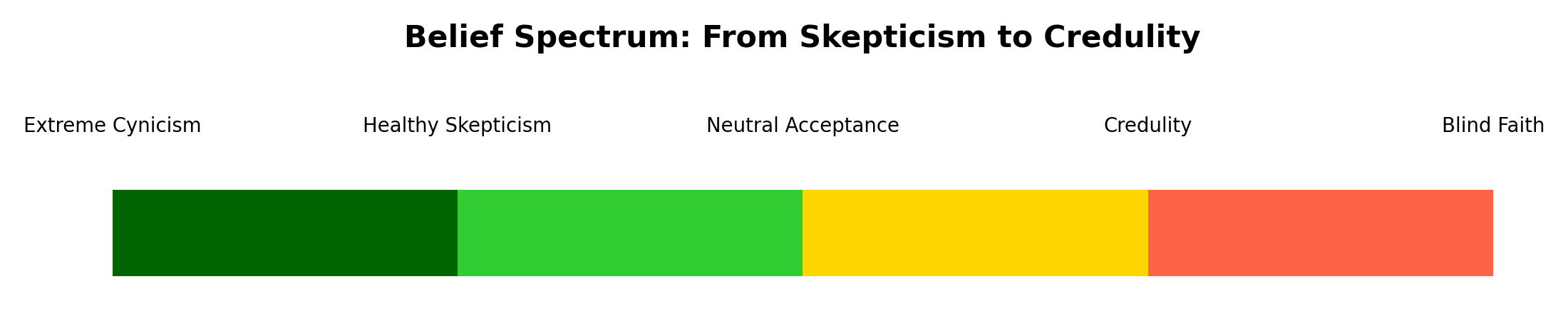
Belief Spectrum: From Skepticism to Credulity
- Extreme Cynicism (far left): Overcorrection—rejects almost everything, stifles collaboration.
- Healthy Skepticism: Evidence-based, open-minded questioning.
- Neutral Acceptance: Balanced trust—evaluates claims but less rigorously.
- Credulity: Unquestioning acceptance—high risk of misinformation.
- Blind Faith (far right): Complete acceptance without evidence—maximum vulnerability.
Conclusion
In a world saturated with information, the ability to question, verify, and think critically is not just an intellectual exercise; it is a survival skill. Developing skepticism can empower individuals to navigate complexity, resist manipulation, and make evidence-based decisions, fostering a sense of agency and hope for positive Impact.
Skepticism is not a barrier to trust; it is a guardrail for truth. In business, science, and everyday life, those who master the art of questioning are not contrarians; they are the architects of progress.