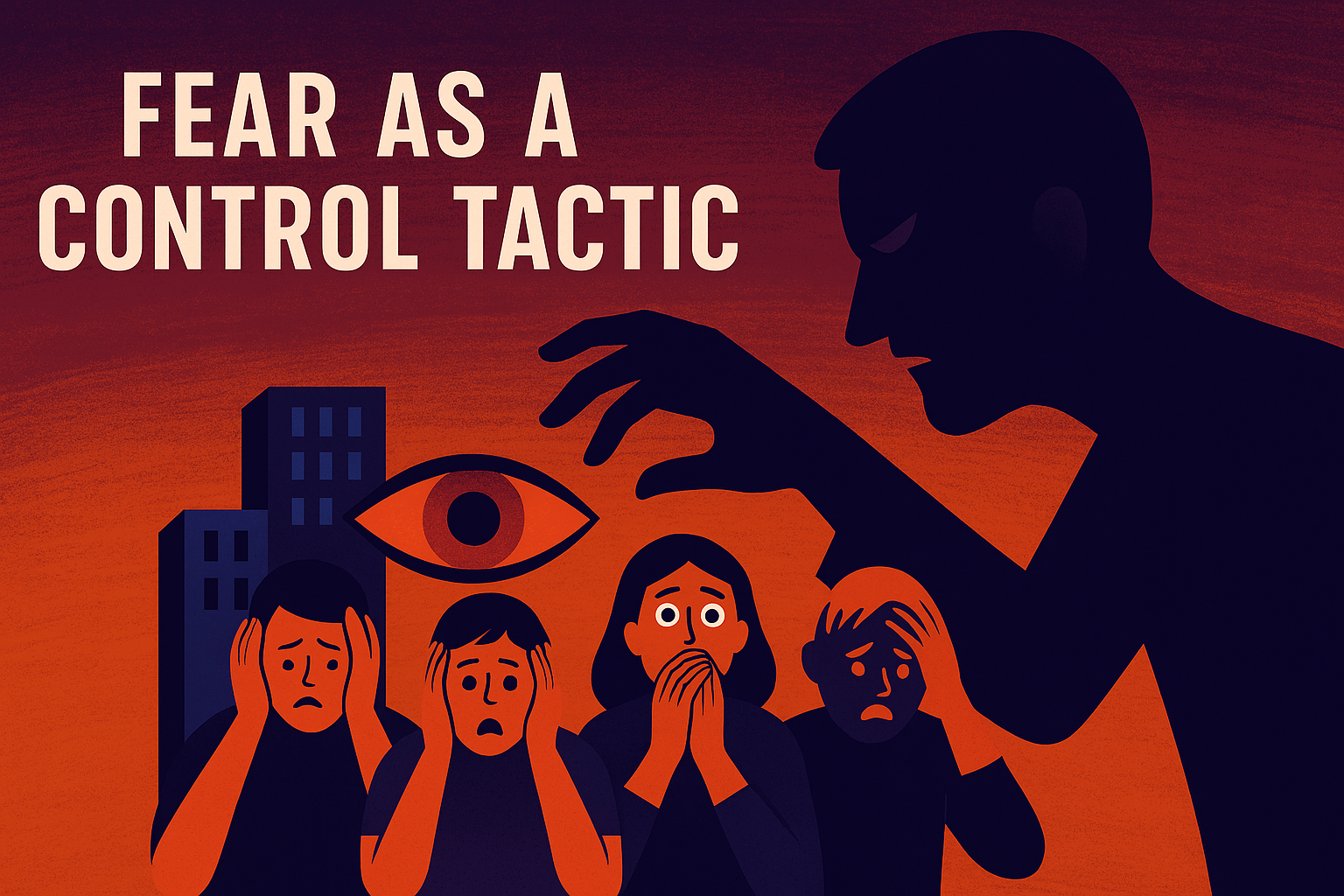
Fear, Perception, and Technology in Modern Society
Any population, especially one as large and diverse as America, can be manipulated when individuals are reduced to a collective, simplified mindset. Once people are conditioned to think and act as a herd, autonomy erodes. Individual intellect, the foundation of freedom, is replaced by conformity, making centralized control inevitable.
The more the government dumbs people down, the easier they are to control. Keeping most ordinary people uneducated, isolated from the truth, and manipulated into submission is a relatively easy task, as we witnessed in the manufactured COVID fraud and the Climate Change fraud.
People were foolish enough to drive around in their cars alone on a sunny day, windows up and masks on, as a badge of political submission- fear, screaming “follow the science.” Yes, COVID-19 was a severe influenza period, but COVID-19 had Been Identified more than 20 years earlier. The real reason was to transfer wealth to the top-tier rich people by making them systemically important and subordinating the bottom 90 of Americans to isolation through fear. The rich people were systemically important, and everyone else was not.
Perception as Reality
In today’s world, reality is often defined by perception. When powerful interests engineer perception, truth becomes malleable. This inversion—from personal autonomy to a manufactured collective consciousness—creates mental confusion, enabling top-down governance. Propaganda and indoctrination have long been tools for this purpose, gradually dismantling independent thought.
Historical Parallel
This is not new. In the 1930s, totalitarian regimes mastered propaganda to reshape reality. Nazi Germany’s Ministry of Propaganda, led by Joseph Goebbels, controlled media narratives to create a collective worldview that justified tyranny. Similarly, the Soviet Union used state-controlled press and education to enforce ideological conformity.
The AI Factor: Convenience or Control?
The final stage of this transformation is the integration of artificial intelligence into every facet of life. While marketed as progress and convenience, AI-driven digitization—such as digital currency, biometric IDs, and virtual interactions—risks severing authentic human connection. Reality exists in the present moment, yet a fully digitized society pushes individuals into a simulated existence, detached from what is real.
Historical Parallel
Just as industrialization centralized economic power in the 19th century, digitization centralizes informational and behavioral control today. Where factories once controlled labor, algorithms now control thought.
Fear as a Mechanism of Power
Fear dominates the modern worldview. It is a manufactured perception, not reality, yet it drives behavior. When fear governs thought, people retreat into illusions rather than confront truth. This psychological manipulation dulls the senses and fosters compliance, paving the way for authoritarian systems.
Historical Parallel
During the Cold War, fear of nuclear annihilation justified massive military spending and surveillance programs. Today, fear of pandemics, terrorism, and economic collapse serves the same purpose—expanding state power under the guise of protection.
Tools of Tyranny
Surveillance technologies, “smart” devices, AI systems, and media hype are not neutral innovations—they are instruments of control. They obscure real suffering—war, poverty, financial collapse—while distracting the public with curated narratives. A population absorbed in headlines and political theater poses no threat to systemic power.
Historical Parallel
The Stasi in East Germany maintained control through pervasive surveillance and informant networks. Today’s equivalent is digital: smartphones, social media, and data mining create a far more efficient system of monitoring.
Economic and Social Engineering
Economic crises, political polarization, and cultural conflicts are not random—they are strategic. By keeping the public fixated on fear and division, ruling elites maintain dominance. Voting rituals and partisan battles become theater, while structural control deepens behind the scenes.
Historical Parallel
The Roman Empire’s “bread and circuses” strategy distracted citizens from political decay. Modern equivalents include media spectacles and consumer culture, which pacify populations while power consolidates.
Pharmaceutical and Educational Conditioning
Generational indoctrination begins early. From state-run schools to widespread pharmaceutical dependency, society is conditioned to accept authority and suppress critical thought. This is not accidental; it is a deliberate design to elicit compliance.
Historical Parallel
Authoritarian regimes historically controlled education to mold obedient citizens. Today, the combination of standardized schooling and chemical dependency achieves similar ends under a democratic façade.
The Consequence: A Nation of Obedience
The result is a population that escapes reality through illusions, embracing a state-structured existence. This raises a sobering question:
Are we witnessing the rise of a society where millions have been taught what to think, but almost no one has been taught how to think?
Fear as a Political Instrument
Fear is one of the most effective tools for consolidating political power because it fundamentally alters human behavior. When people fear war, disease, economic collapse, or social unrest, they prioritize safety over liberty. This psychological shift makes populations more willing to surrender freedoms in exchange for perceived security.
Mechanisms of Fear-Based Control
· Legitimizing Authority:
Governments often frame themselves as protectors against existential threats. Fear creates urgency, allowing leaders to bypass debate and implement sweeping measures—emergency powers, surveillance programs, and censorship—under the guise of public safety.
· Suppressing Dissent:
Fear discourages opposition. Those who question official narratives risk being labeled as dangerous or disloyal, thereby isolating dissenters and reinforcing conformity.
· Redirecting Attention:
Fear diverts attention from systemic failures. Economic mismanagement, Corruption, and erosion of rights are overshadowed by crises—real or manufactured—that dominate headlines.
Historical Precedents
- Ancient Rome: “Bread and circuses” pacified citizens while fear of external enemies justified military expansion.
- Cold War Era: Fear of communism enabled McCarthyism and mass surveillance programs in the U.S.
- Post-9/11: Terrorism fears led to the Patriot Act, expanding government surveillance and reducing privacy rights.
- Totalitarian Regimes: Nazi Germany and Stalinist Russia used fear of internal and external enemies to justify authoritarian control.
Modern Application
Today, fear is amplified by 24/7 media cycles and social platforms. Pandemics, climate catastrophes, and geopolitical tensions dominate narratives, creating a perpetual state of anxiety. This environment makes populations more receptive to technocratic solutions—digital IDs, AI-driven monitoring, and centralized governance—under the promise of safety.
Fear plays a central role in modern politics because it is one of the most effective tools for shaping public opinion and consolidating power. Here’s how it works:
1. Fear Creates Compliance
When people feel threatened—by terrorism, pandemics, economic collapse, or social unrest—they prioritize safety over liberty. This makes them more willing to accept surveillance, emergency powers, and restrictions that they would usually resist.
2. Fear Justifies Extraordinary Measures
Politicians often frame policies as necessary responses to existential threats. For example:
- Post-9/11: Fear of terrorism enabled the Patriot Act, expanding government surveillance.
- Pandemic Response: Lockdowns and digital tracking were justified as “public health measures,” even when they curtailed freedoms.
3. Fear Distracts from Systemic Issues
Crises dominate headlines, diverting attention from Corruption, economic mismanagement, or erosion of rights. Fear becomes a smokescreen for deeper structural problems.
4. Fear Polarizes Society
By amplifying fears of immigrants, climate catastrophe, or political opponents, leaders create division. This fragmentation weakens collective resistance and strengthens centralized control.
5. Fear Amplified by Media and Technology
24/7 news cycles and social media algorithms magnify fear-based narratives. Real-time updates, viral panic memes, and sensational headlines keep populations in a constant state of anxiety, making them easier to influence.
Bottom line: Fear is not just an emotion—it’s a political strategy. It transforms citizens into subjects by making security seem more important than freedom.