Summary
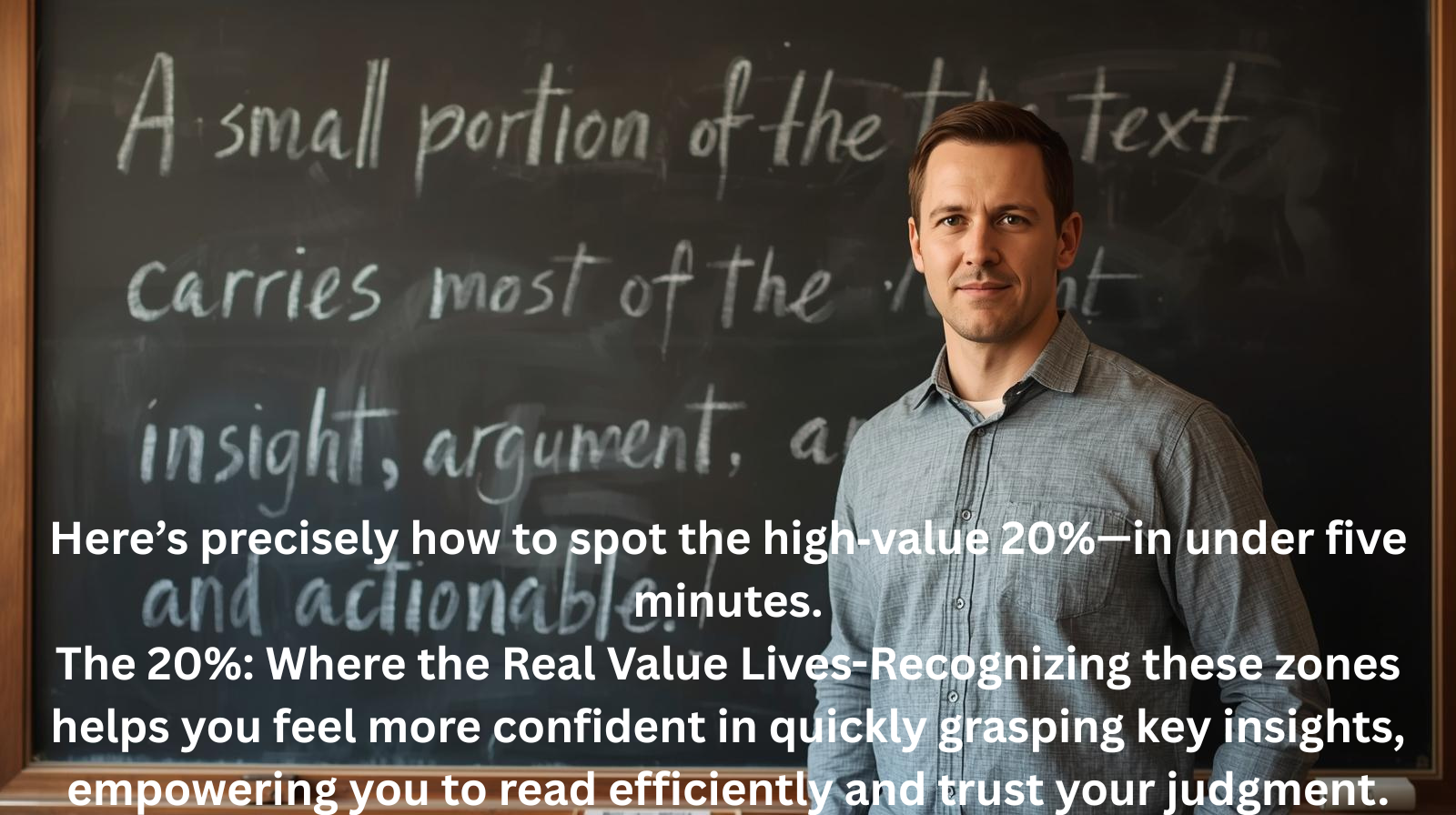
A small portion of the text carries most of the insight, argument, and actionable value. The rest is support, filler, narrative, or redundancy.
1. Title + Subhead (2–5% of value)
The thesis, scope, and promise are almost always encoded right here.
Look for:
- The main problem the article claims to solve
- The implied audience
- The angle or unique claim
This is the most compressed value in the entire piece.
2. The First Two Paragraphs (10–12% of value)
Professional writers front-load value.
You will typically find:
- The central claim
- The context
- The stakes
- Sometimes, the entire argument in summary form
If the intro doesn’t summarize the value, that’s already diagnostic—quality is lower.
3. Subheads + Topic Sentences (10% of value)
This is one of the wealthiest veins of information.
Topic sentences = condensed arguments.
Subheads = structural logic-understanding this helps you feel more in control, making your reading faster and less stressful.
When you read:
- Subhead
- First sentence under it
…you’re usually getting:
- The argument
- The takeaway
- The transition to the next idea
This alone often provides 70–80% of the understanding.
4. Data, Examples, and Named Sources (2–5% of value)
This is where credibility and insight live.
Look for signals:
- Numbers
- Quotes
- Case studies
- Named experts or institutions
These are rare, dense, and loaded with meaning.
They tell you:
- How strong the argument is
- Whether the writer did real research
- What’s actually true vs. rhetorical
5. The Final Paragraph (2–3% of value)
Professional writers land the plane cleanly.
Here you’ll usually find:
- The biggest takeaway
- The “so what?”
- The call to action, lesson, or implication
This is disproportionately valuable compared to the middle.
THE 80%: What You Can Safely Skim or Skip
1. Long Anecdotes
These are usually narrative padding to:
- Hook emotion
- Build context
- Slow the reader down
Maybe interesting—not essential.
2. Transitional Paragraphs
Any paragraph that:
- Connects one idea to the next
- Recaps something you already know
- Reframes rather than advances
…is part of the 80%.
Look for words like:
- However
- On the other hand
- Another example
- Before we continue…
These are structural glue, not core values.
3. Over-Explanation
If a paragraph:
- Restates an idea in multiple ways
- Uses metaphors to clarify something simple
- Shows multiple examples for one principle
…it’s repetition, not value.
4. “Scene Setting” and Descriptive Flourish
Magazine features often include:
- Environmental description
- Character sketches
- Historical color
- Emotional framing
These enrich the experience—not the insight.
5. Low-Density Paragraphs
These usually:
- Are long
- Contain no numbers, no names, no argument
- Are vague or abstract
- Rely on generalities
Train your eye to see density per square inch.
A 10-Second Shortcut: Value Density Scan
Run your eyes down the page looking for:
High‑Value Indicators (read these thoroughly):
- Bold text
- Subheads
- Numbers
- Bullet points
- Named sources
- Short paragraphs
- Verbs of action (shows, reveals, explains, proves)
Low‑Value Indicators (skim or skip these):
- Long blocks of text
- Sentences without specifics
- Redundant phrasing
- Introductory or transitional filler
The Fastest Formula: 20% Reading Sequence (Guaranteed)
Read in this order:
· Title + Subhead
· First 2 paragraphs
· Subheads only
· First sentence of each section
· All numbers and names
· Conclusion
You’ve hit the value-dense 20%.
Then—if needed—you dip back into the 80% that supports the significant insights.