Summary
In its healthy form, it’s how historians improve our understanding of the past when new evidence or better methods emerge. In its unhealthy form, it’s a rhetorical mask for distortion, denial, and propaganda—the deliberate reshaping of memory to serve an agenda.
What does Historical Revisionism mean?
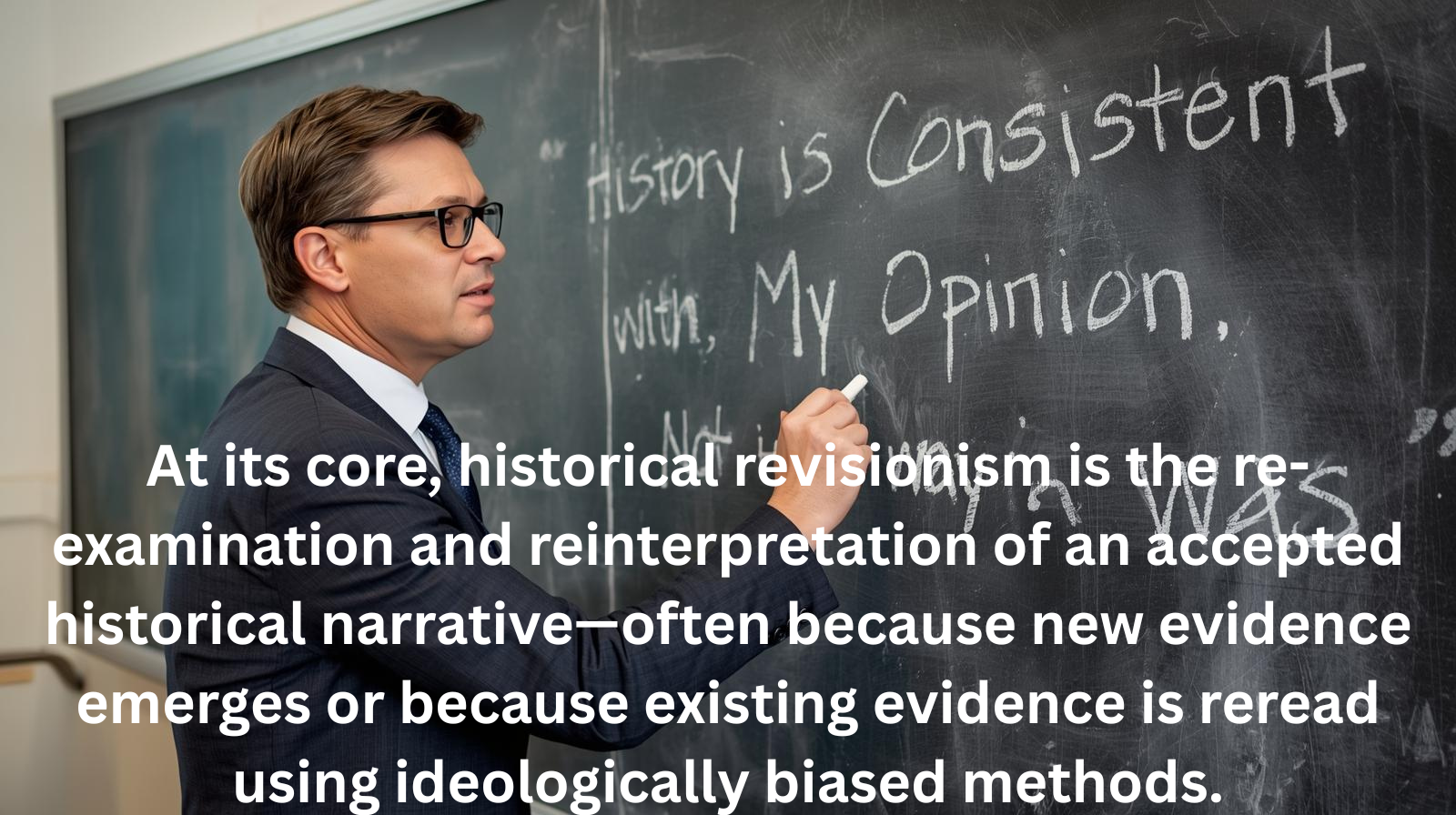
At its core, historical revisionism is the re-examination and reinterpretation of an accepted historical narrative—often because new evidence emerges or because existing evidence is reread using ideologically biased methods.
This is normal in scholarship because History is built from incomplete traces of “what happened,” and historians continually argue over how best to interpret those traces.
In plain terms:
- Legitimate revisionism = updating the story to get closer to the truth.
- Illegitimate “revisionism” (often better called denialism/negationism) = bending the story to fit a goal.
“Real revisionism follows evidence; fake revisionism follows an agenda.”
Why is this important
1) Because History shapes what a society thinks is true
Organizations of professional historians warn that ideological “scrubbing” and censorship can distort, manipulate, and erase parts of the record—making the past “unrecognizable” and less usable for learning.
When public access to documented History is restricted or selectively edited, it ceases to be an honest account and becomes a curated narrative.
2) Because distortion fuels hatred and weakens democratic judgment
Major Holocaust education institutions emphasize that denial and distortion undermine truth and our understanding of History, and are often tied to broader prejudice and conspiratorial claims.
UNESCO similarly notes that, in the digital age, historical facts can be threatened by manipulation and falsification, <b>highlighting</b> the importance of critical thinking and media literacy to empower audiences against misinformation.
When people can’t agree on basic facts about the past, they can’t reason clearly about the present.”
How “bad revisionism” distorts History, facts, and truth
A helpful way to think about distortion is this: propaganda isn’t just lies—it’s selective storytelling designed to influence beliefs. Britannica defines propaganda as the dissemination of information (including half-truths or lies) to influence opinion, often by selecting, omitting, or distorting facts.
The most common distortion tactics
1) Cherry-picking evidence
Selecting only the sources that support a predetermined conclusion—while ignoring contradictory documentation—mirrors propaganda’s deliberate selectivity.
2) Omission by “scrubbing”:
Removing key terms, context, or groups from public materials can erase significant parts of the record, which professional historians describe as a campaign to distort and manipulate History.
3) “Just asking questions” to seed doubt. Denial and distortion often function by casting doubt on facts without offering credible, evidence-based alternatives.
4) Minimization and reframing.
The IHRA working definition (as described by the U.S. Department of State) identifies gross minimization, excusing perpetrators, and shifting responsibility as common forms of distortion.
5) Conspiracy substitution.
Denial and distortion frequently replace evidence with conspiracy claims (e.g., “it was invented/exaggerated for political gain”), which the USHMM notes is characteristic of Holocaust denial and distortion narratives.
“Distortion doesn’t need to erase every fact—only the ones that make the story inconvenient.”
The key distinction: Revisionism vs. Denialism
This is the part most readers need bold and clear:
- Legitimate revisionism is evidence-driven revision—historians revise interpretations because new evidence or better methods change what’s most plausible.
- Denial/negationism is the falsification, trivialization, or distortion of the record—often using methods that don’t belong in serious historical inquiry.
In other words, good revisionism tries to reduce error; bad “revisionism” tries to minimize accountability.
Checklist
When you see a “revisionist” claim online, ask:
· Does it cite primary sources clearly—and can you verify them? (Scholarly revision relies on evidence and method.)
· Does it confront counterevidence honestly? (Education presents multiple sides; propaganda omits and manipulates.)
· Is the argument trying to “explain better,” or to “erase blame”? (Denial/distortion often aims to negate facts or shift responsibility.)
· Are you pushed toward outrage and certainty instead of inquiry? (Propaganda is designed to influence beliefs.)
· Is the claim anchored in conspiracies rather than documentation? (A known pattern in denial and distortion.)
Conclusion
Historical revisionism isn’t automatically bad—it’s how History gets modified to fit someone’s narratives—the problem, truth, and fact are left out entirely. A red flag is when “revisionism” becomes a cover for denial or distortion: scrubbing context, minimizing harms, shifting blame, or replacing documentation with conspiracy. That matters because distorted History doesn’t just misinform—it reshapes what the public believes is true, making democratic judgment harder and prejudice easier to spread.