Introduction
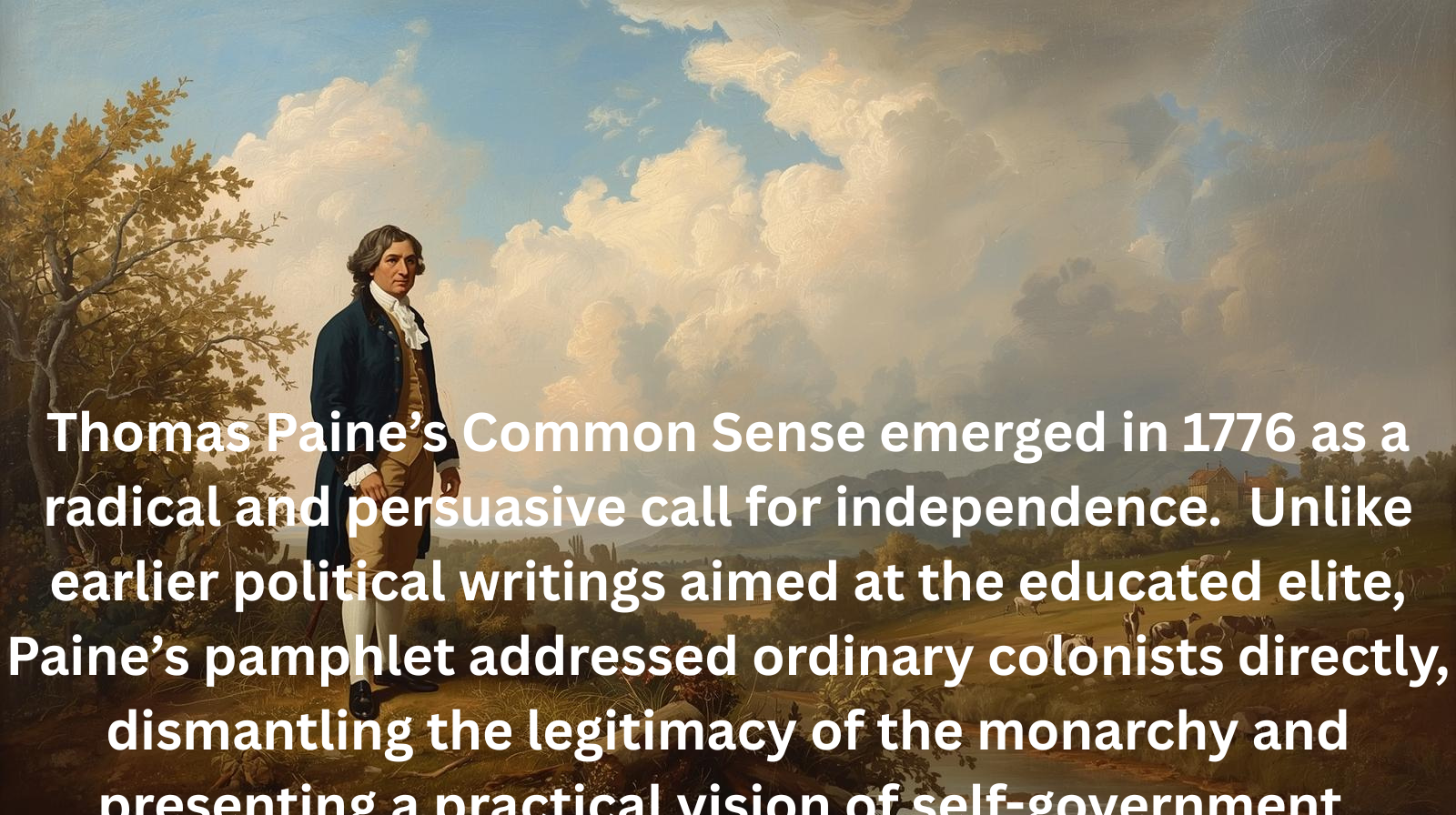
During growing tension between Britain and its American colonies, Thomas Paine’s Common Sense emerged in 1776 as a radical and persuasive call for independence. Unlike earlier political writings aimed at the educated elite, Paine’s pamphlet addressed ordinary colonists directly, dismantling the legitimacy of the monarchy and presenting a practical vision of self-government. His clear, forceful language and bold arguments transformed widespread frustration into a unified revolutionary movement, making the goal of independence seem attainable and inspiring hope among colonists. As one of the most influential works of its era, Common Sense not only accelerated the push for independence but also reshaped the political discourse of a nation on the brink of revolution.
Does this remind you of where we are today: the establishment narrative, the deep state apparatus, government intrusions, and Government by the elites, for the economic benefits of the elites, with the commoners expected to sit silently and obediently?
Quote:
“A government of our own is our natural right.” — Thomas Paine, Common Sense.
Article
Historians such as David Hackett Fischer note that Paine’s genius lay in his ability to articulate sentiments already stirring in the hearts of colonists (Fischer, 2004). His words transformed growing discontent into a powerful call for independence. Remarkably, Paine had only arrived in the colonies two years earlier, in 1774.
The reception of Common Sense varied across regions and social classes. Woody Holton observes that Virginia farmers embraced Paine’s ideals to demand greater influence in local governance (Holton, 1999). Unlike Thomas Jefferson, who cataloged specific grievances in the Declaration of Independence, Paine attacked the very foundations of monarchy, arguing that hereditary rule was an absurd relic. This distinction underscores Paine’s direct challenge to the legitimacy of monarchy, making his arguments more radical and accessible to the ordinary colonist. His accessible style—plain language and vivid analogies—distinguished Common Sense from earlier political tracts aimed at the educated elite, thereby broadening its appeal among ordinary colonists.
Quote:
“Society is produced by our wants, and government by our wickedness.” — Thomas Paine.
The pamphlet unfolded in three major sections. After a brief introduction, Paine launched a scathing critique of the British monarchy. He then examined the plight of the colonies, portraying Americans as second-class citizens under British rule. Finally, he argued for independence, emphasizing America’s abundant resources and thriving industries—particularly its shipbuilding industry—as evidence of its capacity for self-sufficiency and future strength. Because its arguments were considered treasonous, Paine published the work anonymously.
The Impact was extraordinary. Common Sense sold approximately 12,000 copies in its first three months and more than half a million copies within a year, with 25 editions. Paine donated his royalties to the Continental Army, underscoring his commitment to the revolutionary cause.
Although Common Sense galvanized support for independence, the hardships of war soon dampened enthusiasm. To rekindle morale, Paine penned The American Crisis, whose opening line—“These are the times that try men’s souls”—became legendary. Paine continued to write influential works, including Rights of Man (1791), a cornerstone of Enlightenment thought, and he played a role in the French Revolution. His later criticism of organized religion, however, made him controversial, and he died in relative obscurity.
Quote:
“These are the times that try men’s souls.” — The American Crisis
Conclusion
Thomas Paine’s Common Sense was more than a pamphlet—it was a turning point in American History. By rejecting monarchy and championing self-government in language accessible to ordinary colonists, Paine fostered a sense of unity and shared purpose. Its unprecedented popularity helped unify public opinion and accelerate the revolutionary movement, making colonists feel part of a collective effort to shape their future. Although Paine’s later life was marked by controversy and obscurity, his work remains a cornerstone of democratic ideals and a testament to the power of clear, persuasive writing to shape the course of nations and to inspire a sense of collective agency among readers.