China’s Silent Economic Offensive
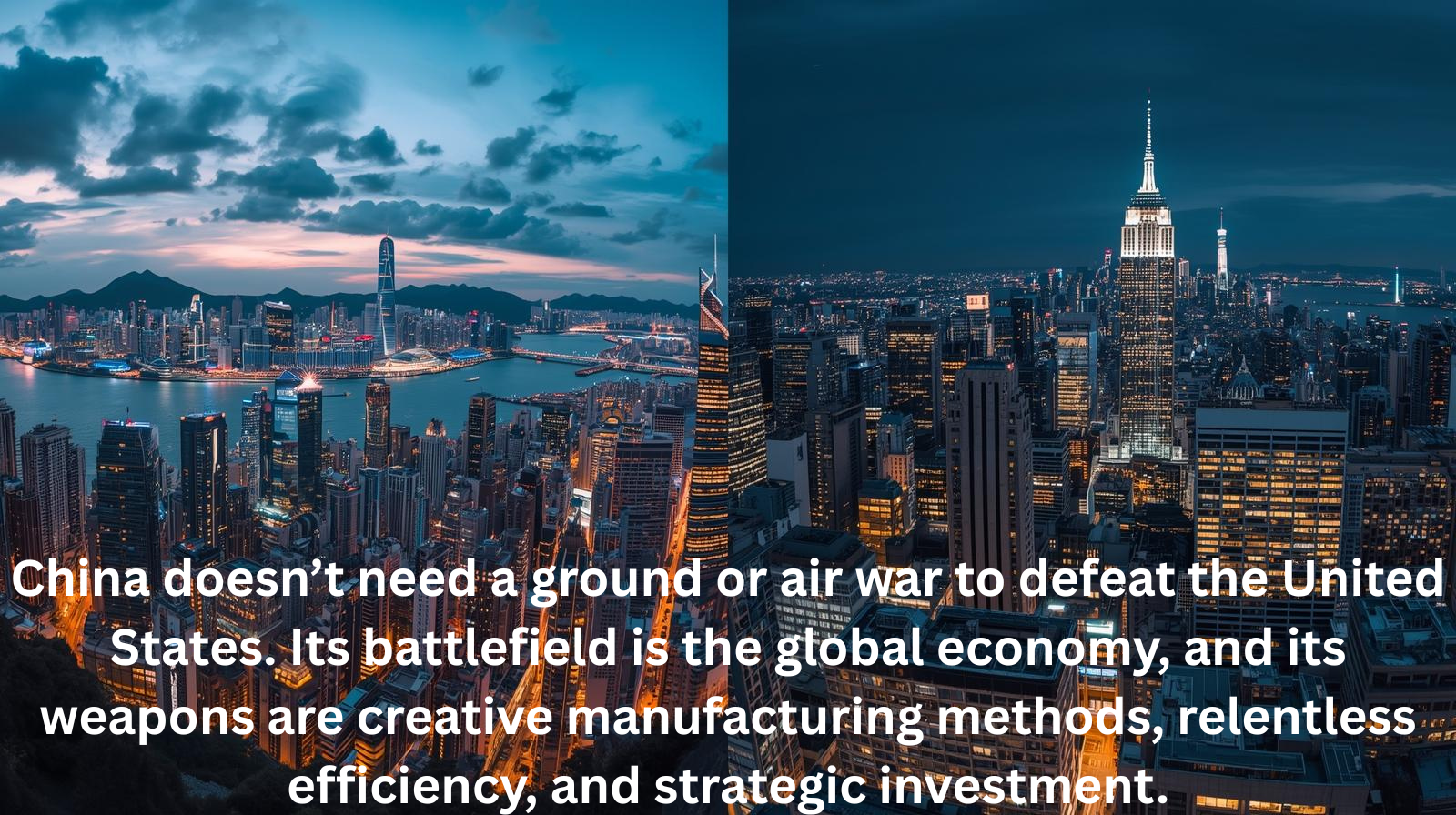
China doesn’t need a ground or air war to defeat the United States. Its battlefield is the global economy, and its weapons are creative manufacturing methods, relentless efficiency, and strategic investment.
By combining:
- Advanced manufacturing ecosystems that integrate robotics, AI, and supply-chain optimization.
- Aggressive cost control and scale, enabling dominance in EVs, batteries, and electronics.
- Infrastructure diplomacy through the Belt and Road Initiative, securing trade routes and resource access.
- Mission-driven R&D to leapfrog in semiconductors, AI, and green tech.
China is building an economy that is fast, adaptive, and globally embedded, while the U.S. struggles with bureaucratic inertia, fragmented priorities, and reactive policy cycles. The U.S. must act decisively to stay ahead.
Examples of China’s manufacturing tactics that have given it a decisive edge:
1. Vertical Integration
China consolidates entire supply chains—from raw materials to finished goods—into a single ecosystem. For example:
- EV Industry: Chinese firms such as BYD control battery production, vehicle assembly, and even lithium mining, thereby reducing costs and dependence on foreign suppliers.
2. Scale and Speed
Factories operate at a massive scale with rapid production cycles:
- Electronics: Shenzhen’s manufacturing hubs can prototype and mass-produce new devices in weeks, compared to months in the U.S.
3. Automation and Smart Factories
China invests heavily in robotics and AI-driven manufacturing:
- Industrial IoT: Smart sensors and predictive maintenance optimize uptime and reduce waste, boosting efficiency.
4. Aggressive Cost Optimization
- Labor and Logistics: Strategic clustering of suppliers near ports and rail reduces transportation costs and lead times.
- Energy Efficiency: Factories leverage renewable energy and government subsidies to cut operational costs.
5. Government-Backed Industrial Policy
- Made in China 2025: Targets dominance in high-tech sectors like semiconductors, aerospace, and biotech through subsidies, tax breaks, and R&D grants.
6. Rapid Product Iteration
- Consumer Electronics: Chinese firms release multiple product versions quickly, using real-time market feedback to refine designs—something Western firms struggle to match.
7. Export-Oriented Clusters
- Special Economic Zones (SEZs): These zones offer tax incentives and streamlined regulations, attracting foreign investment and enabling high-volume exports.
Made in China 2025 is a strategic industrial policy launched by Beijing in 2015 aimed at transforming China from a low-cost manufacturing hub into a global leader in high-tech industries by 2025.
Here’s what it entails:
Core Objectives
- Move up the value chain: Shift from labor-intensive, low-margin production to advanced manufacturing.
- Reduce foreign dependence: Achieve self-sufficiency in critical technologies such as semiconductors, robotics, and aerospace.
- Global leadership: Position China as a dominant player in emerging sectors, including electric vehicles, AI, and green energy.
Key Target Sectors
· Next-Generation IT (semiconductors, AI, cloud computing)
· High-End CNC Machinery & Robotics
· Aerospace Equipment
· Advanced Rail Equipment
· Energy-Saving & New Energy Vehicles
· Power Equipment
· Agricultural Machinery
· New Materials
· Biopharma & High-End Medical Devices
Tactics
- Massive subsidies and tax incentives for domestic firms.
- State-backed R&D programs and national innovation centers.
- Technology transfer requirements for foreign companies operating in China.
- Aggressive IP acquisition through joint ventures and overseas investments.
Impact
- China has become the world’s largest EV producer and battery manufacturer.
- Significant progress in robotics and high-speed rail.
- Still faces challenges in the semiconductor and aerospace sectors due to U.S. export controls.
10 target sectors in the Made in China 2025 plan:
Sectors Included:
· Next-Generation IT
· High-End CNC Machinery & Robotics
· Aerospace Equipment
· Advanced Rail Equipment
· Energy-Saving & New Energy Vehicles
· Power Equipment
· Agricultural Machinery
· New Materials
· Biopharma & High-End Medical Devices
· Marine Engineering & High-Tech Ships
Made in China 2025 timeline chart showing key milestones:
Milestones:
- 2015: Launch of the Made in China 2025 strategy
- 2020: Mid-term progress review and sectoral adjustments
- 2025: Target year for achieving dominance in 10 strategic sectors
- 2030: Vision for global leadership in advanced manufacturing and technology
China’s 2030 goals that build on the Made in China 2025 strategy:
· Global Leadership in Advanced Manufacturing
· Dominate high-tech sectors such as semiconductors, AI, aerospace, and robotics.
· Achieve near-complete self-sufficiency in critical technologies.
· AI Superpower Status
· Lead in artificial intelligence research, applications, and industrial integration.
· Develop world-class AI chips and computing infrastructure.
· Green Energy Dominance
· Become the largest producer and exporter of renewable energy technologies (solar, wind, EV batteries).
· Reduce carbon intensity while maintaining industrial growth.
· Digital Economy Expansion
· Build globally competitive platforms in e-commerce, fintech, and cloud computing.
· Export digital infrastructure to emerging markets via the Belt and Road Digital Silk Road.
· Military Modernization
· Achieve “world-class military” status with advanced naval, aerospace, and cyber capabilities.
· Expand overseas bases and logistics hubs for global reach.
· Global Standards Setter
· Shape international norms in technology, trade, and infrastructure through influence in multilateral bodies.
· Promote Chinese technical standards in 5G, EVs, and smart manufacturing worldwide.
China’s plan to lead in Artificial Intelligence (AI) is multi-layered and deeply integrated into its national strategy.
Here’s how:
1. National AI Development Plan
- Goal: Become the world’s primary AI innovation center by 2030.
- Phases:
- 2017–2020: Build foundational AI capabilities.
- 2020–2025: Achieve breakthroughs in core technologies (machine learning, computer vision, NLP).
- 2025–2030: Global leadership in AI applications and standards.
2. Massive State Investment
- Billions have been allocated for AI research hubs, national laboratories, and computing infrastructure.
- Government-backed funding for AI chips, cloud platforms, and data centers.
3. Talent Development
- Expansion of AI-focused university programs and vocational training.
- Incentives for top global AI researchers to relocate to China.
- AI integrated into K–12 curricula to build a future-ready workforce.
4. Data Advantage
- China’s large population and digital ecosystem generate vast datasets, fueling machine learning at scale.
- Looser data privacy regulations than those in Western countries allow faster experimentation.
5. Industrial Integration
- AI is embedded in manufacturing, logistics, healthcare, finance, and smart cities.
- Strategic sectors like autonomous vehicles, facial recognition, and predictive analytics are prioritized for global export.
6. AI Chips and Hardware
- Heavy investment in domestic semiconductor production for AI accelerators.
- Partnerships between state-owned enterprises and private firms to reduce reliance on U.S. chip technology.
7. Global Standards and Diplomacy
- Push to set international AI norms through participation in ISO and ITU.
- Export of AI-enabled surveillance and innovative city systems to Belt and Road countries.
Call to Action for U.S. Policymakers
The United States stands at a crossroads. The global economic contest will not be won through rhetoric or incremental adjustments—it demands bold, structural reform. Policymakers must:
- Cut through bureaucratic inertia that paralyzes infrastructure and innovation.
- Commit to long-horizon investments in mission-driven R&D and advanced manufacturing.
- Rebuild human capital pipelines to ensure a skilled workforce for tomorrow’s industries.
- Reassert U.S. influence abroad through transparent, values-based economic diplomacy and strategic partnerships.
- Modernize defense acquisition to redirect resources toward next-generation capabilities.
- Create a pro-growth environment that rewards innovation rather than punishes success.
The time for action is now. Every year of delay widens the gap and cedes ground to China’s disciplined, long-term strategy. America must choose to lead—or risk becoming a follower in the new global order.
Quote:
“We need to cut through the red tape, streamline regulations, and unleash American innovation to compete and win in the global economy.”
— Gina Raimondo, U.S. Secretary of Commerce (on CHIPS Act and competitiveness)
Closing Paragraph
China’s ascent is not the result of chance—it is the outcome of deliberate, long-term planning and disciplined execution across infrastructure, technology, and global influence. While the United States remains a powerhouse of innovation and democratic resilience, its competitive edge is eroding due to bureaucratic inertia, fragmented priorities, and reactive policymaking. The economic contest will not be won on the battlefield but in boardrooms, research labs, and global markets. To reclaim leadership, America must act boldly: dismantle systemic inefficiencies, invest in mission-driven innovation, modernize its workforce, and reassert its presence on the world stage through tangible, values-based engagement. Delay is defeat—the time for decisive reform is now.