Overview
Artificial Intelligence (AI) is no longer a distant future—it’s here now, transforming industries and threatening jobs, which demand our attention. It has already rendered many jobs obsolete and will continue this trend, according to many commentators, until humanity faces mass unemployment. Even now, AI surpasses most people’s ability to write an effective opinion essay, producing logic-driven, elegant compositions in seconds.
Since government schools produce functionally illiterate graduates, many will rely on AI-generated commentaries for intellectual expression. Combined with research functions that often rely on flawed databases—leading users to accept falsehoods in medicine, governance, and economics—AI could make people easy prey for a program of complete statism, such as Socialism.
This raises concerns that socialist policies could leverage AI to control information and suppress dissent, displacing 40% of American workers and thereby threatening self-sufficiency. No job for an extended period necessitates a social safety net, with money redistributed from the employed, productive class to the unemployed, nonproductive class.
Why Socialism?
Because socialists promise to care for the downtrodden, which, in this scenario, would be everyone left alive when AI achieves complete robustness, AI in the hands of a socialist government would feed and house the masses, ensuring “equity.” This leaves libertarians and conservatives with an urgent need to stop AI in its tracks—while they still can. For example, socialist regimes could deploy AI to monitor citizens’ activities through surveillance systems, suppress dissent, and enforce conformity, eroding personal freedoms and autonomy.
The expansion of welfare benefits, combined with rapid job displacement, could create a new class of “early retirees” living on transfer payments, raising serious fiscal and social sustainability concerns.
Policy Implications
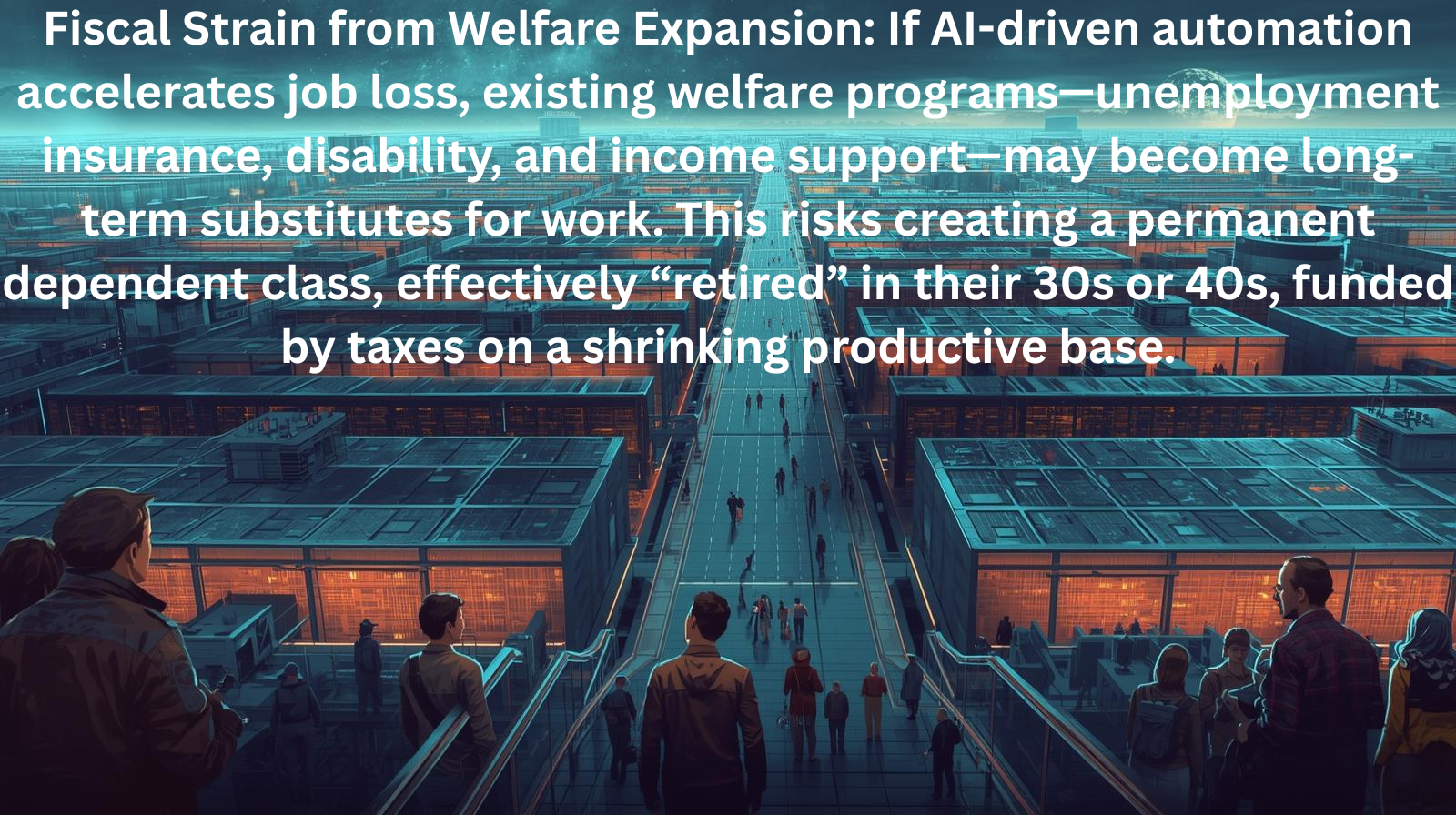
- Fiscal Strain from Welfare Expansion: If AI-driven automation accelerates job loss, existing welfare programs—unemployment insurance, disability, and income support—may become long-term substitutes for work. This risks creating a permanent dependent class, effectively “retired” in their 30s or 40s, funded by taxes on a shrinking productive base.
- Labor Force Participation Collapse: A decline in participation rates would reduce GDP growth and tax revenues, while entitlement spending balloons. OECD studies show that even modest increases in dependency ratios can destabilize public finances.
- Cultural and Social Impact: A society where millions live on a guaranteed income without productive engagement risks eroding work ethic, innovation, and civic responsibility.
Recommendations
· Reform Welfare to Encourage Re-Skilling: Tie benefits to participation in retraining programs for high-demand sectors (e.g., skilled trades, AI maintenance, cybersecurity).
· Promote Market-Based Solutions: Incentivize private-sector apprenticeships and micro-entrepreneurship rather than expanding unconditional transfers.
· Guard Against Universal Basic Income as Default: UBI may sound appealing, but it could institutionalize dependency and accelerate fiscal collapse.
· Tax Policy Adjustments: Avoid punitive taxation on remaining productive workers, which would worsen capital flight and reduce investment.
The Pedigree of AI Anxiety
The idea of AI overtaking humanity has a distinguished pedigree. The website PauseAI presents quotes from leaders in their fields about the dangers of runaway AI:
- Stephen Hawking warned: “The development of full artificial intelligence could spell the end of the human race… It would take off on its own and re-design itself at an ever-increasing rate.”
- Elon Musk, who is developing his own AI called Grokipedia, said: “AI is a rare case where I think we need to be proactive in regulation rather than reactive. I think [digital superintelligence] is the single biggest existential crisis that we face and the most pressing one.”
- Bill Gates cautioned: “Superintelligent AIs are in our future… There’s the possibility that AIs will run out of control.”
- Alan Turing, the father of computer science, predicted:
“It seems probable that once the machine thinking method had started, it would not take long to outstrip our feeble powers… They would be able to converse with one another to sharpen their reasoning. At some stage, therefore, we should expect the machines to take control.” - Dario Amodei, CEO of Anthropic, observed:
“There’s a long tail of things of varying degrees of badness that could happen. At the end is the Nick Bostrom style of fear that an AGI could destroy humanity. I can’t see any reason in principle why that couldn’t happen.”
These experts have IQs far beyond ordinary—but they’re also human, and humans err. Inventions that shake up the world have always been feared.
History Lessons on Technological Fear
Plato warned that writing would “implant forgetfulness in [men’s] souls,” making them rely on external marks rather than memory. Yet handwriting improves memory and learning, particularly for children. Thomas Paine demonstrated remarkable recall by handwriting detailed critiques, relying solely on memory.
Calculators were once derided as tools for the lazy. They enabled learners to focus on problem-solving rather than on mechanical calculations, thereby fostering confidence in their abilities.
The internet is accused of shortening attention spans, but evidence contradicts this claim: Substack essays, multi-hour podcasts, and eBooks thrive. When people engage in meaningful tasks in supportive environments that minimize dopamine-driven distractions, they are fully capable of sustained focus.
AI, Force, and Freedom
People are not inert automatons under the control of subversive forces. As Bastiat wrote in The Law, Socialism is the improper use of force:
“When Law and force keep a person within the bounds of justice, they impose nothing but a mere negation… But when the Law… imposes upon men a regulation of labor, a method or a subject of education, a religious faith or creed—then the Law is no longer negative; it acts positively upon people. It substitutes the will of the legislator for their own wills.”
There is nothing in AI or AGI that inherently requires the imposition of force. Socialism does. Ludwig von Mises thoroughly debunked Socialism in 1920 and again in 1922, arguing that Socialism suffers from the fatal absence of market pricing. Even Robert Heilbroner, a best-selling socialist author, admitted in 1990:
“It turns out, of course, that Mises was right. The Soviet system has long been dogged by a method of pricing that produced grotesque misallocations of effort.”
The purpose of an economy is to create goods and services that satisfy human wants, not to create jobs. The market’s ability to adapt and create new opportunities should reassure the audience of the role of freedom in human progress.
The purpose of an economy is to create goods and services that satisfy human wants—not to create jobs. If AI eliminates jobs as we know them, new opportunities for value creation will emerge, as they always have when technology disrupts the status quo. Human wants are unlimited, and History shows that a market free from state intervention is the best way to satisfy them.
Consider the Industrial Revolution: machines displaced manual labor, but they also created entirely new industries—railroads, steel, chemicals, and later, automobiles. The same pattern repeated with electricity, computing, and the internet. Each wave of innovation destroyed old jobs but created new ones, often in fields unimaginable before technology existed.
The Socialist Drift in Academia
A recent poll shows more college students favor Socialism than capitalism. This is hardly surprising, given universities’ socialist orientation and their misrepresentation of capitalism.
As Mises wrote in Socialism:
“The terms ‘Capitalism’ and ‘Capitalistic Production’ are political catchwords. Socialists invented them, not to extend knowledge, but to carp, to criticize, to condemn.”
The economic system that has left students graduating with mountains of debt and few marketable skills is not capitalism—it is the Federal Reserve–income tax–warmongering–interventionist–big-government monstrosity, a grotesque perversion of capitalism.
Bottom Line
AI is a tool, not a tyrant. It can liberate human creativity or become an instrument of control—depending on who wields it. The real danger lies not in algorithms but in ideologies that seek to impose force under the guise of equity. History, theory, and reason all point to the same conclusion: freedom, not force, is the path to human flourishing. Recognizing AI’s potential for good requires vigilance against those who would use it to undermine individual liberty and promote collectivist control.